What is Cognitive Behavioural Therapy (CBT)?
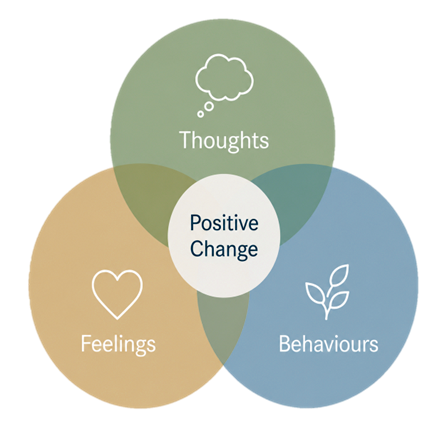
Cognitive behavioural therapy or CBT is a form of therapy which emphasises helping you to develop skills that will support you to not only reach your goals now but also to be able to maintain good mental health long after therapy has finished. All of the techniques used are grounded in scientific research and proven to be effective in managing a variety of problems. Broadly speaking, CBT focuses on two main areas; how we think and how we behave. By addressing these two areas we aim to help you to gain relief and control over how you feel physically and emotionally.
Firstly, there are our thoughts, also known as cognitions. We can all fall in to bad habits or traps in how we think, whether it’s self criticism or struggling with worries. We may also hold certain beliefs which influence our mental health, such as seeing ourselves as a bad person or that we need to be prepared for any possible thing that could go wrong. There are also several processes that can influence how we think, such as biases in our internal threat detection systems, what we pay attention to, or how difficult memories can impact us. In therapy we can help you to understand each of these concepts and learn to develop more control and healthier overall thinking styles. This can include strategies like challenging your thoughts, reframing and internalising troubling beliefs, or processing difficult memories.
Secondly, CBT explores our behaviour patterns. Behaviour patterns that we fall in to can have a powerful impact on how we feel. Our behaviours are often motivated by how we feel and they usually aim to make us feel better. Unfortunately, this can mean that we fall in to habits that make us feel better in the short term but feed our problems in the long term. We may for example become avoidant and withdraw from our friends, lose motivation, or check things over and over again. In targeting this area we can help to identify and reduce any bad habits and help you to develop healthier coping strategies that will help you to reach your goals.
There are also additional factors that we may look at which are more specific to certain difficulties. This can include factors like the impact of trauma on our brain mechanisms, or ability to tolerate uncertainty in anxiety. In the early stages of therapy I will help you to identify and understand these mechanisms more, where relevant.
For further information on CBT you can visit the BABCP website: https://babcp.com/what-is-cbt/
Treatment Structure
CBT is usually offered on a weekly basis for around an hour at a time. The total number of sessions can vary depending on what is being targeted, but usually in most cases you can expect somewhere between 8-16 sessions would be recommended. Treatment will usually involve several key phases.
Initial assessment: In your first sessions we would be working to understand the underlying difficulties that you want to work on. We would clarify your therapy goals and complete a routine risk assessment as well.
Formulation: Following assessment we move on to formulation. This is where we will look at various models to help you to understand the psychological mechanisms around the difficulties we’re working on. Each model discussed will be specific to the problem we are targeting. At this point I will be able to outline each step in our treatment plan in detail.
Main Treatments: The majority of the rest of the sessions will focus on helping you to develop strategies to reach your goals using a combination of cognitive and behavioural techniques. In this phase you may find it helpful to bring a notebook to sessions. We will also be setting home practices for you to have a go at techniques in between sessions and build your confidence.
Final sessions: In our final one or two sessions the focus will be on helping you to maintain your progress going forwards after therapy has finished. I will help you to create a robust plan to keep your momentum and manage any dips that you may run into. At our final session we may also discuss any recommendations for future support or I may signpost you to helpful organisations for specific issues outside of the scope of CBT.